Dawit repeated the name softly, the hard, crisp letters snapping in his mouth. It sounded strong, full, the name of a man. He smiled, nodded. “I’m Mekonnen.” He paused. “Your real name’s not Solomon?”
“We’re finished here.” It was when Solomon dug in his pocket for another cigarette that Dawit noticed his hands for the first time: shaking, uncontrollably loose-limbed. There was a pause and then a look from the other man before both shifted their eyes away from momentary shame.
 This novel is an addicting read, very difficult to put down, despite it being about a devastating revolution, torture, and military occupancy told through the lives of one family. It takes place in Ethiopia in 1974, when the revolution starts, the emperor dies, and a rule of terror begins. Although I had some idea of the country’s history, this novel sparked my interest even more, and the moment I finished, I spent hours reading about its history.
The novel begins with Dr. Hailu, a very respected doctor, whose dying wife’s wish is for him to let her go at last. He has two son: Yonas, the eldest, who works at the university, is scared of breaking any rules, has a wife, Sara, and a daughter, Tizita; and Dawit, a young man with a revolutionary spirit and his mother’s favorite. Dawit soon begins to hand out pamphlets against the Derg, the military government, putting his life and his family in danger. Dawit’s best friend from childhood, Mickey, is a soldier, recently promoted who struggles with the lust for power and the atrocities the Derg commits. At first he confides in Dawit, but as their political interests divert, their friendship comes to an end.
Each character faces the country’s revolution from different angles, living horrifying events that they cannot share for fear of being caught. Dr. Hailu has to treat a tortured, agonizing patient with only the help of his trusted nurse, and is soon brought in to the Derg for questioning. Dawit and Sara collect dead bodies from the streets and bring them back to their families for them to have a burial, and Tizita’s friend, who is only 6 years old, suddenly has to work for a living.
It is not a difficult read in terms of language, Mengiste is an excellent narrator, with descriptions so vivid, they are unforgettable and unforgiving. It is a difficult read in terms of the violence its characters endure, in very few novels does the reader have to read pages and pages of torture and frustrations. I wanted both to stop reading and read faster to finish each scene. Yet, it is a great and powerful novel that I deeply recommend.
About Maaza Mengiste
Maaza was born in Addis Ababa in 1971, just 3 years before the coup d’état. Her nuclear family was forced to leave the country, and some of her family members were victims of the war. Her novels deal with revolution, war, migration and exile. Beneath the Lion’s Gaze, which was named one of the best books of 2010 by multiple sources, is her first novel. She is also a human rights activist.
Other books written by Ethiopian women
We only recommend books we’ve read
Which books do you recommend? Please let us know in the comment section!
Ethiopian initiatives and projects that support and empower girls and women
Girls Gotta Run Foundation
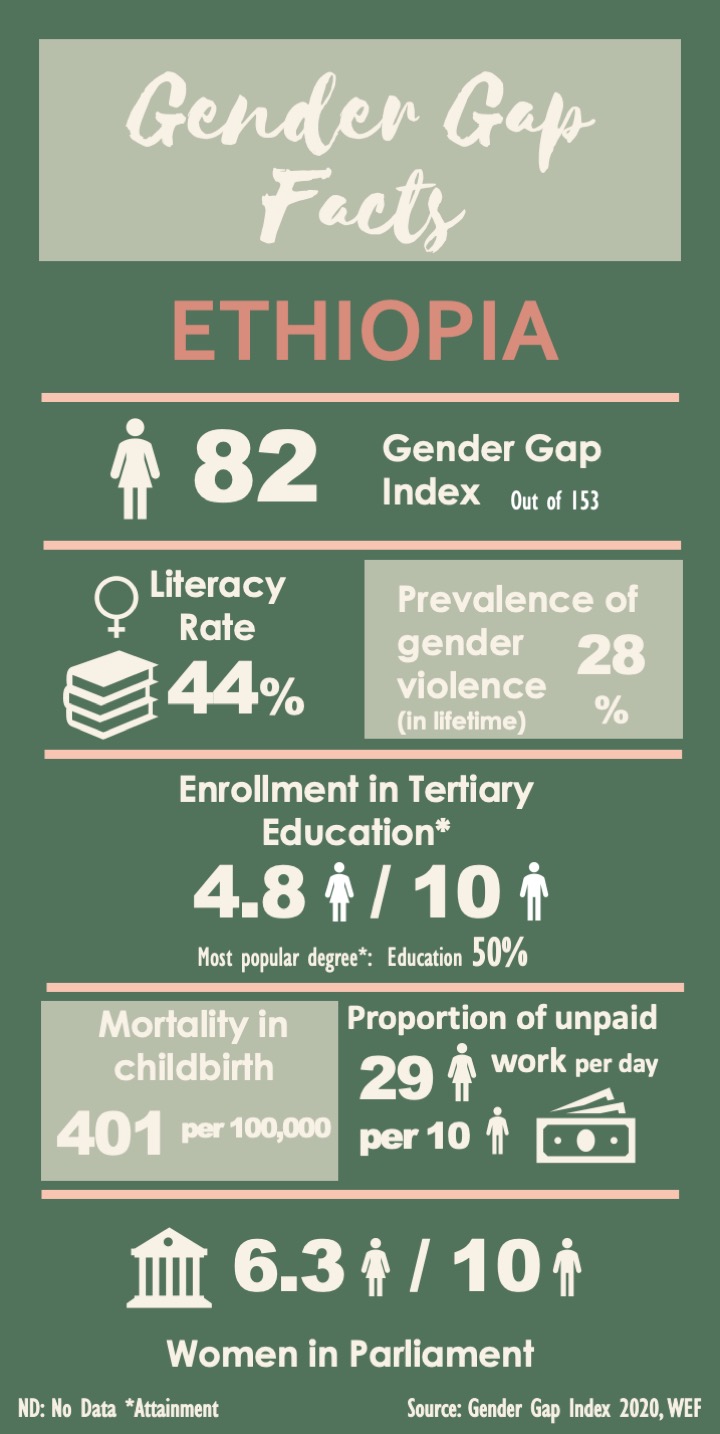 In Ethiopia, even though 95% of girls start their education, only 10% finish through grade 12. With this motivation, the foundation invests in girls who use running and education to empower themselves and also their communities. Their approach is based on four strategies: investing at the right time (adolescence, when they are most prone to drop out of school), working with the families to created high impact innovations, partnering with local organizations, and sustainable programming (investing in the financial resilience of families). To achieve their mission they provide scholarships for girls to attend school, as well as a running training program that does not interfere with school. On Saturdays, they hold a life skill workshop where they also build community, and finally, they work with the girls’ mothers to design a savings plan for their education.
 The Map of Fiction by Women