She dragged the lame stool July had supplied ‘for the children’ out where she had a view of the bush and began. But the transport of a novel, the false awareness of being within another time, place and life that was the pleasure of reading, for her, was not possible. She was in another time, place, consciousness; it pressed in upon her and filled her as someone’s breath fills a balloon’s shape. She was already not what she was. No fiction could compete with what she was already finding she did not know, could not have imagined or discovered through imagination.
They had nothing.
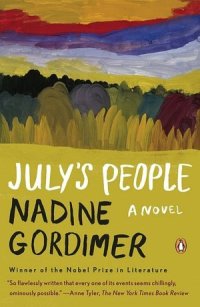 I always wanted to read a book by Nadine Gordimer, in fact, I started a few but could never finish them. This blog gave me the opportunity to finish July’s People – a short yet extremely powerful novel-, one that I would’ve like to read in a literature class or with an expert’s guidance. When I first started, the language was difficult for me, I had to re-read various paragraphs to grasp the images and feelings Gordimer wanted to portray. As I kept reading, I was captured by words and could not stop reading. Every line is a reflection about a reality and an invitation to think about life, the purpose of life and what it means to different people that share the same space.
July’s People follows a rich South African family, the Smales, which includes Bam, the father, Maureen, the mother, and three children, in a time of riots and uncertainty, and how they are “saved” by July, their servant for 15 years. The author does a masterful job describing a difficult, yet life-depending, relationship between the masters and July. The country’s political situation semi-inverts the relationship where they now depend on July for survival. He is the person that leads them to a safe place, provides food and shelter, in spite of what his wife, mother and community tell him. He helps in the most unusual of circumstances and, in his own particular way, takes advantage of some things – like using their car.
It is a story of two worlds that coexist in the physical space and how they collide due to an external force. A story of how the Smales have to live by new rules -as guests, white and privileged – and still maintain hope that the situation will change. The children, as children are, are resilient and quickly merge with the other children, but Bam and Maureen face a transforming reality. A reality where the role of women shares some basic features, but have different rules. Where meeting the community’s chief is a matter of life and death and where having walls made out of mud is a luxury. Although it is written in third person, through Maureen’s eyes, Gordimer unwraps the layers of a complicated relationship, master and servant, husband and wife, that is placed in the most vulnerable of circumstances.
Although this book follows the story of a crisis of 1960, it is not far from many situations the world is living today, and despite it being hard and raw, I encourage everyone to read it and then, re-read it.
About Nadine Gordimer
Nadine Gordimer was a writer and political activist from Springs, South Africa. She started writing when she was young and published her first novel when she was 15 years old. She wrote short stories, essays and novels with strong political criticism, some of them – including July’s People – where banned because she was part of the anti-apartheid movement.
She won the Nobel Prize in Literature in 1991 for her “epic writing.”
Other books written by South African women
We only recommend books we’ve read
What book do you recommend? Please let us know in the comment section!
South African initiatives and projects that support and empower girls and women
18twenty8
 This organization’s mission is to empower young South African women through education and professional development. With programs and activities, such as helping girls finish high school in marginalized communities, providing financial assistance for expenses for undergraduate women students, mentorships and recruitment workshops they have changed the future of these women. They also follow the professional path of the women that have graduated college with their help to create a strong network and tell their stories.
 The Map of Fiction by Women
Interesting and compelling. Thank you!
LikeLiked by 1 person