Se dice que para incumplir las normas
primero hay que conocerlas.
Por eso yo he escrito todas las normas que me salto,
para demostrar que no me las salto sin saber,
sino que me las salto sabiendo y queriendo.Es un acto de rebeldía.
Rebeldía es cuando no estás de acuerdo con una norma
y te la saltas.
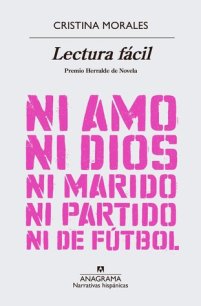 After reading Lectura Fácil the only thing I can say with complete certainty is that Cristina Morales is a brilliant writer. However, I had so many mixed feelings while reading this book. It was hilarious but exhausting, smart but showy, ingenious but phony… Likewise, I’m not sure to whom I would recommend this book; it’s not for everyone, yet I know some who will love it. And contrary to its name, which means Easy Reading, it’s really hard to read.
The book follows the life of four relatives: Angels, Patricia, Marga and Nati, all of whom are regarded as intellectually disabled by the Spanish government. They spend most of their adult lives in various centers for people with disabilities until they find a way to move into a state-supervised flat in Barcelona. The plot centers around Marga’s decision to move out of the flat into a squat apartment and the consequences of that decision.
The narrative techniques that Morales uses to tell the story are genius. It involves first person point of view, transcripts of the squatter’s meetings, judicial depositions, a fanzine and an autobiographical book (of one of the characters) that follows the style of Lectura Fácil, a way of writing that simplifies the text so it’s accessible to all. Each technique focuses in one character, and in each, Morales manages to create a bond between the reader and these women -even when narrating judicial depositions, which were weirdly hilarious-. It is also remarkable how Morales plays with time -the storytelling is far from linear – feels like solving a puzzle that starts taking shape after three quarters of the book.
The whole book is a critique of the patriarchal system and its institutions, of the “normal” and of the “proper” through the eyes of the most vulnerable. However, the weakness of the book is that at some points it felt more like an anti-establishment pamphlet than a real critique. Specifically, Nati’s chapters are repetitive and sometimes even needless, which instead of giving strength to the most vocal and nonconforming character, it makes it tedious. Still, it is a book worth reading because of its endearing characters, and because it’s innovative, funny and it deals with uncomfortable topics that not many people dare to write about.
About Cristina Morales
Cristina Morales was born in Granada, Spain, but lives in Barcelona. She studied International Law, and besides writing fiction, she worked as a legal interpreter and belongs to the dance company Inciativa Sexual Femenina. Lectura Fácil won the Premio Herralde de novela, one of the most prestigious prizes for literature in Spanish.
Other books written by Spanish women:
We only recommend books we’ve read
Which book do you recommend? Please let us know in the comment section!
Spanish initiatives and projects that support and empower girls and women
Asociación Hèlia
Hèlia is a non-profit organization set in Barcelona formed by volunteers and professionals who provide support to women affected by gender violence, to fully recover from any taken harm, constantly researching a way to fulfill affected women’s needs; networking and creating projects to intervene in gender violence.
They have multiple projects where they work at local level, like Barcelona Dona in which they organize activities and cultural initiatives with groups of women who, for whatever reason, have found themselves isolated. By organizing play-therapeutic meetings ( theater, concerts, children’s shows…) and allowing survivors of sexist violence to participate they seek to rebuild their social network to give them strength to recover from their violent experience.
 The Map of Fiction by Women
I also had difficulties to keep on reading it. But I agree she is brilliant with language, and developing the disgressions of each character. Its a scathing critique to the “triumphs” , or maybe fails? of Democracy
LikeLiked by 1 person