In her orchard the trees had been born from deaths; they marked and grew from the remains of the children that passed through her. She never picked the fruit that fell from them, believing it a kind of cannibalism, but out of those soft, unshaped figures had grown tall, strong, tough-barked trees that blossomed and called birds to their branches and clambered out over the orchard walls to the world beyond.
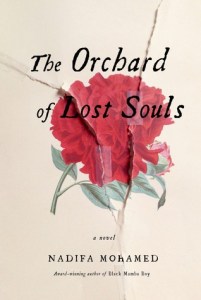 The Orchard of Lost Souls tells the story of the period leading to -and the first few days of- the 1988 civil war in Somalia from the point of view of three women that have little in common, but that their lives are intertwined by chance in a military parade: Deqo a nine-year-old orphan that grew up in a refugee camp and decides to look for a new life in the city, Filsan a young soldier trying to follow and, at the same time, break from her father’s military career and Kawsar an old widow from a middle-class neighborhood with a broken hip that leaves her confined to bed until the end of her days.
Since Mohamed writes about war from a rare angle, that of women, we’re presented with new ways of understanding armed conflict and the role of the “other” half that is usually relegated to the background or to a passive role. She shows that women not only have an unmatched capacity of resilience in times of conflict, but are also capable of inflicting pain and of committing acts of pure violence. The difference of age and backgrounds between the three protagonists shows us a whole range of experiences. The three characters are incredibly interesting and complex, but Filsan, the soldier, is exceptional. Women soldiers are usually not represented, women soldiers from the African continent less so, and women soldiers from the African continent fighting for the oppressor side is something I had never seen before, nor in media nor in a fictional setting. This was for me completely groundbreaking and it shattered my preconception of who actively participates in armed conflicts.
The novel is beautifully written and through her story she builds up the tension as the conflict days approach with little events in each of the women’s everyday lives that show us how the north of the country slowly wakes up from a drowsy period under a military dictatorship. We notice how these events start to accumulate until the revolution is imminent, and when it starts, Mohamed manages to convey the violence of the Somali civil war, that was extremely crude and vicious, without being melodramatic. And there’s another element of her writing technique that I found extremely interesting: the structure. The book is written in five chapters, in the first and the last, the stories of the women are linked, but each of the three central chapters is dedicated to one woman. While reading, I felt like it would be better to mix the story lines a little since the time frame was the same, but then I understood the effect that Mohamed wanted to achieved. She wants the reader to feel the absolute loneliness of these three women – which is the only thing they have in common- and believe me, she succeeds.
About Nadifa Mohamed
Nadifa Mohamed was born in Hargeisa (now in the Republic of Somaliland) and moved as a child to England, staying permanently when war broke out in Somalia. Her first novel, Black Mamba Boy (which I’m dying to read), based on her father’s memories of his travels in the 1930s, was long-listed for the Orange Prize for Fiction (now Women’s Prize for Fiction).
Other books written by Somali women:
We only recommend books we’ve read
Which book do you recommend? Please let us know in the comment section!
Somali initiatives and projects that support and empower girls and women
SWSC is an organization that brings positive change in Somali women and girls’ lives through building their capacity and confidence to participate in decision making, articulate their specific needs and exert their agency through calling for participation, representation and solutions that will effectively address marginalization and gender inequalities the country. They have multiple programs that address different issues that women face in post-conflict Somalia. One of their most successful programs is one in which they trained and mentored a total of 1,600 women to build women’s leadership skills, courage and confidence to participate in leadership positions. During the 2016 elections in Somalia, over 30 out of the 1,600 women trained by SWSC were elected as members of parliament at the Federal government and Federal state government levels.

 The Map of Fiction by Women