“…we belong to a city invested in storytelling. It is in our blood. But you can only be familiar with those you know well, you can only know the stories of those to whom you’ve bothered to listen. What happens to all those streets that hold no stories for us? Do we simply stay away from them?”
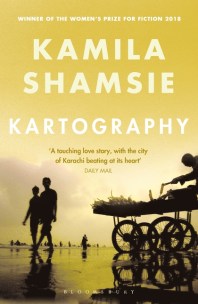 Raheen and Karim are destined to be together, they’ve known each since childhood and have spent every waking moment with each other. They both love anagrams and complete each other phrases, until Karim obsesses over maps and for the first time in their thirteen years, they have something not in common. Raheen, the daughter of Zafar and Yasmin, and Karim the son of Ali and Maheen, both have families that belong to the upper class in Karachi, Pakistan. The four adults know each other since their teen years, and originally Zafar was meant to marry Maheen and Ali to marry Yasmin, but as they told their children, “the music changed”. The book follows Raheen and Karim until their twenties, with constant stories of their parents.
The whole story turns around Karachi in times of conflict, the main plot line takes place from the end of the eighties to the mid-nineties, during the Muhajir conflict, an ethnic conflict that turned the city into a battlefield. The secondary plot happens in 1971, the year of the Indo-Pakistani war. Shamsie makes an excellent job at making Karachi the protagonist of this book and that is probably what I liked the most about it. Karachi defines the stories of all the characters, it pushes them away and then draws them back. Karachi is the magnet that keeps the characters together across time.
The story deals with many topics: ethnicity, religion, gender. Yet, the most important one, that is subtly (and not so subtly) present throughout the book, is privilege. Raheen and Karim belong to well-off and well-connected families in Karachi, and the same rules don’t apply to them. As the conflict escalates, they lose their access to the city, the private-sphere becomes their main sphere, but in contrast with the average Karachiite they have that option. They can choose how reckless they want to be. They can find refuge in their country clubs or private parties, where the new rules of a more conservative Karachi don’t apply and they can pretend everything is the same. Ethnic conflict affects their social status but does not put their life in risk. And when everything collapses, they can always leave, and come back, and leave again.
This is the second book I read by Kamila Shamsie. The first one I read is her last, Home Fire, and this one is part of her early works. In this case it is obvious that she has matured incredibly as a writer. Kartography is a good book, with very strong parts and some beautiful prose, however there are some weak moments both for the plot and the writing style (in many cases I thought that improving it was a job for the editor, not necessarily for the author). Home Fire, on the other hand, is almost a perfect book. However, I loved that Kartography takes us as readers to places we seldomly can go, specially for those of us from other parts of the world, and that’s what makes it special and worth reading.
About Kamila Shamsie
Kamila Shamsie was born in 1973 in Karachi, Pakistan. She comes from a family of writers. While growing up, during the time of political turmoil in Karachi, she found a refuge in books. She studied Creative Writing and a MFA in the US. Now she divides her time between London and Karachi. Like Kartography, most of her early work focuses in the city she grew up in.
Other books written by Pakistani women:
We only recommend books we’ve read
- Home Fire – Kamila Shamsie (read by Ceci)
Which book do you recommend? Please let us know in the comment section!
Pakistani initiatives and projects that support and empower girls and women
Malala Fund
 Malala is a young activist from Pakistan, and the youngest Nobel laureate. She won the Noble Peace prize in 2014. In 2012, when she was 15, she was shot in the head by a member of the Taliban for speaking in favor of girls’ education. She survived the attack and afterwards she made her lifelong mission to bring education to girls around the world through the Malala Fund. In Pakistan, the Malala Fund has invested $6 million in work for girls’ education, from opening the first secondary school for girls in Shangla, Malala’s hometown, to supporting Gulmakai Champions, a program that supports local educators and activists to understand the issues girls face in their communities and develop suitable solutions.
 The Map of Fiction by Women