Writing in a foreign language, not in either of the tongues of my native country – the Berber of Dahra mountains or the Arabic of the town where I was born – writing has brought me to the cries of the women silently rebelling in my youth, to my own true origins.
 Fantasia: An Algerian Cavalcade is one of those books with so many layers, metaphors and meaning that to fully understand it you probably need to complement it with a lecture, or at least a second reading. It was definitely not an easy book to read. Actually, if it hadn’t been part of this project, I would’ve probably abandoned it mid-book. I’m so glad I didn’t. It’s a magnificent novel (if novel is the aplicable term), maybe free-style long essay would be more appropriate; a “fantasia”.
Although hard to grip, a plot exists. Djebar tells her own story as the daughter of a French school professor. She had the privilege to learn to read and write French, and then attend a French boarding school in an Algerian city where she enjoyed a freedom that most girls her age did not. At the same time, living in “French” cuts her off from the Arabic traditions and costumes, especially as a woman. Djebar loses the veil, physically and metaphorically, but feels lost in her own world. This book is a conscious effort by Djebar to reconcile her French education with the Arabic world.
Her story is intertwined with war chronicles of the conquest of Algeria. These sections were extraordinary. Djebar manages to recount historical episodes with opposing versions: the “traditional” history told by the French imperialists and the oral recollections of the Algerian people. The writing style was so intense and the level of detail so deep that I could hear the cries of the suffering people, smell the bodies of the dead and feel their pain. It’s a part of history that we are rarely taught, at least in my education.
Also intertwined, there are short chapters of other women’s voices (one of which could also be considered part of the main plot) that recall their experiences in the Algerian independence war in the 1950s. All the stories are very similar, sometimes they even feel like a collective memory told from the point of view of different women. Through these chapters, Djebar shows the indispensable role women played in the movement, from giving food, shelter and clothing to the fighters, to women that gave all they had for the freedom of their country. Djebar writes their stories so they are not forgotten.
Again, this book is many times messy, the plot is slow, and even a bit pretentious. However, the more I read it, the more I liked it, and slowly started to put the pieces together. Each chapter is a mosaic, only at the end, one can zoom out and understand the horrors and vestiges of imperialism and the role of women in Algeria. I’ll definitely revisit the book at some point. I’m sure there are many things I’m yet to understand about it.
About Assia Djebar
Assia Djebar is the pen name of Fatima-Zohra Imalayen. She was born in Cherchell, Algeria in 1936. She was the first writer from the Maghreb to be elected to the Académie Française. For her achievement as a writer in all her works, she was awarded the 1996 Neustadt International Prize for Literature. Djebar died in Paris in 2015.
Other books written by Algerian women:
We only recommend books we’ve read
Which book do you recommend? Please let us know in the comment section!
Algerian initiatives and projects that support and empower girls and women
The Wassila Network 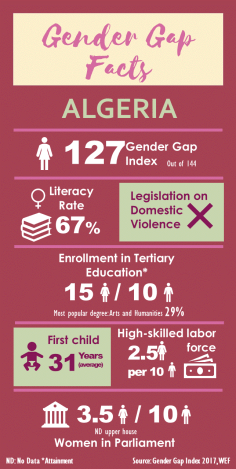
The Wassila Network is a coalition of several Algerian associations whose objective is to participate in a better care and guidance of women and children victims of all kinds of violence. The Wassila Network fights for the eradication of violence and discrimination against women, fighting for egalitarian laws and proposing amendments to the criminal law to make justice more responsive to gender-based violence.
 The Map of Fiction by Women