“Me asalta la sospecha que en el fondo Muñeco sólo sea la suma potenciada de todos nosotros. Los monicongos son dos, y el más chiquitito se parece a vos. Se parece a ti, y a ti, y a ti, y en el fondo es idéntico a mí. En Muñeco podríamos mirarnos como en un espejo, uno de esos de feria, que te distorsionan hasta la monstruosidad, sin que dejes de ser tú mismo el que asoma.”
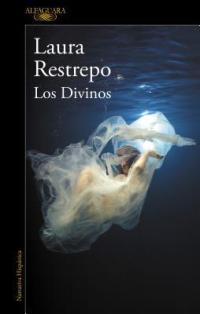 When I stepped into the bookstore, I was determined to buy a novel by Restrepo. This specific bookstore had five of her books, and the eager salesperson recommended “Los Divinos,” without hesitation or slight consideration for the other four. I stepped outside the bookstore without knowing the brilliantly written but absolutely terrible novel I had between my hands.
What first caught my interest was the freshness of the Colombian Spanish she uses. Restrepo’s dominance of writing gives the novel a sense that it is both narrated in written language and told like a friend retelling a story to other friends during a long night of drinks. Even the names of the characters, that are also the titles of the chapters, capture that closeness with the readers because she includes all the nicknames the characters are referred to as (Muñeco alias Kent, Kento, Mi-lindo, Dolly-Boy, Chucky). As the narrator, Hobbit, tells the story he refers to his friends – the members of the Tutti Frutti gang – with a different nickname each time, the nickname that corresponds to that character’s façade at the specific point of this non-linear story. This fictional retelling of a true event is the “coming of age” story that never culminates, where we explore the darkness of the characters who never grow up and commit a terrible crime.
As readers, our main contact and point of view of the events is Hobbit, the main character with a secondary role in the unravelling of events. A person caught up in the middle of crime committed by a high school friend, a friendship that he no longer understands. Despite his depressive existence, where he spends all day playing Angry Birds and eating pizza, he unlocks the story in a most brilliant way. Waking up to drunken phone calls about monsters, retelling the gang’s high school days, and the most recent get-togethers playing poker. Restrepo dominates this male narrative in such a convincing way that I felt goosebumps from beginning to end.
The story itself is horrifying. I have no words to describe how crestfallen I felt when I read the crime itself – I wanted to read with my eyes closed and pretend it was fiction. Nevertheless, I was able to finish the novel both out of curiosity and a hope for punishment, as I imagine most readers do. The narrative is convincing at a universal level, where even though everything about the novel is Colombian, the monsters that live inside people, disregarding their backgrounds and nationalities, cannot always be suppressed and, at night, they come out to hunt the most vulnerable beings.
This book is not yet translated into English, but Restrepo has other works that have been translated and probably have a more cheerful tone or at least less shocking. Check out Delirium, for example.
About Laura Restrepo
Laura was born in Bogotá, Colombia in 1950. She is both a writer and a journalist, and usually intertwines both professions in her novels. As an activist, she once met García Márquez working at a magazine called Semana. Her writing usually reflects her feelings towards poverty, abuse of power and inequality, and when she is not writing, she teaches at Cornell University. She wrote her first novel, The Island of Passion, published in 1989, while being an exile in Mexico. Los Divinos is her tenth novel.
Other works by Colombian authors we recommend
We just recommend books we’ve read
Which book do you recommend? Please let us know in the comment section!
Colombian initiatives and projects that support and empower girls and women
JuanFe Foundation
 This organization promotes gender equality and equal opportunities for all people, especially girls, boys and teen moms. Its two strategic objectives are teen mom empowerment and the reduction of infant mortality rates in Cartagena, Colombia. Their teen mom empowerment program consists of three phases, (1) Psychosocial strengthening of the mothers, (2) Skill building in order to earn a sustainable income, and (3) Employment and Entrepreneurship offices to help them find a suitable job. The most recent graduated class earned a technical degree in Tourism Services. The founder, Catalina Escobar, is a Top 10 CNN Hero.
 The Map of Fiction by Women
[…] to read a woman writing about women (the last two books I read “The Hamilton Case” and “Los Divinos” follow a very masculine voice). The novel, as the title expresses, is about ten women and […]
LikeLike
I recommend Spiral of Silences by Elvira Sánchez-Blake, translated by Lorena Terando. Available in Northwestern University press. It is a novel about the impact of Colombia’s conflict, and centers on the experiences of women who move through hopelessness, loss, and grief during this volatile era in Latin American history.
LikeLiked by 1 person