“I explained that most great works of the imagination were meant to make you feel like a stranger in your own home. The best fiction always forced us to question what we took for granted. It questioned traditions and expectations when they seemed too immutable. I told my students I wanted them in their readings to consider in what ways these works unsettled them, made them a little uneasy, made them look around and consider the world, like Alice in Wonderland, through different eyes.”
“Reading Lolita in Tehran” is, by the far, the best book for a book club because it is indeed a book about a book club. In 2012, I read it in a book club that took place every Thursday morning. It is a memoir that engages with the readers in the first sentence, because the author, Nafisi, is putting her story out there for us to know how she lived this part of Iranian history. It even starts with a disclaimer that states that some characters and storylines where changed to protect those characters. Nafisi is letting the readers in on her secrets, but protecting her students at all costs. The close connection to the author and her feelings at every moment is easy to follow, even if the story does not follow a chronological order, it flows like the way you remember a memory.
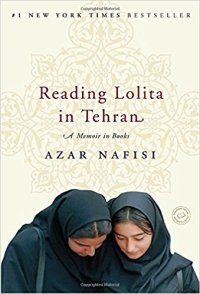 My favorite part was to identify my book club members with the characters from the story; Manna, Mitra, Azin, Sanaz and the others. I could not relate to their life events given that the story takes place during Iran’s political turmoil, but I could relate to their style, both living life and interpreting books. They read Lolita, Gatsby, James (Daisy Miller and Washington Square) and Austen (Pride and Prejudice). For me, reading the book was like taking a very long literature class with Nafisi, listening to her analysis, engaging in her Gatsby trial, sharing her comings and goings from Iran to USA and back, feeling heart broken when university professors were expelled, and mostly, understanding how she lived a revolution and, in the end, rejoiced of being a woman and a writer.
I recently had the honor of listening to Azar Nafisi at the International Book Fair this past September in Guadalajara, Mexico. She began by praising Mexican tomatoes because they had the same taste and texture as Iranian tomatoes, which she truly missed. Then she talked about her life in the USA, about missing an imaginary Iran she had created, but most of all, she spoke of the power of fiction. How it can bring people together, make people travel to every corner of the world and denounce world leaders and their practices, because “dictators are afraid of imagination”. At the end, she asked readers “to not forget the books, to read them and by reading them, give them a new name and resurrect and redefine them.”
About Azar Nafisi
Azar Nafisi is an Iranian author living in the United States. She has a PHD in English and American Literature from the University of Oklahoma. Until recently, she was a Fellow at the Foreign Policy Institute at John Hopkins University. As she shares her memoir in the novel, we learn how she was expelled from the University of Tehran and eventually return to the United States. In her conferences, like the one I attended to, she discusses the political implications that fiction can have and she places responsibility on the readers. I am excited to read her most recent novel, “The Republic of Imagination: America in Three Books,” where she explores and intertwines three books with her story in the United States and the corresponding history of the country.
Other books written by Iranian women
- Persepolis – Marjane Satrapi (read by Angelica)
- Disoriental (Négar Djavadi)
Which book do you recommend? Please let us know in the comment section!
Iranian initiatives and projects that support and empower girls and women
Omid Foundation 
Omid Foundation was set in 2004 with the mission to help young Iranian women who underwent traumatic experiences including mental, sexual and physical abuse. It started in response to the legal situation of women in Iran, because the system gives them few rights and there are many women who are victims of abuse. The program is twofold, it includes an education section and vocational training. The education program helps 200 women that range from 15 to 25 years of age in Tehran. This part lasts 2.5 years and it includes English, Math, Computing, Sciences, Arts, Music and other outdoor activities. The vocational training lasts 6 to 12 months. Additionally, they provide women with care, counseling, education, empowerment skills, and most importantly, they give them a safe, non-judgmental place where they can stay at. The idea is to help women heal emotionally, gain stability and re-integrate themselves into society by searching for a job, starting their own business or enrolling in a university once their program is complete.
 The Map of Fiction by Women
[…] reading about Chilean women having read other books with a similar format (“Naondel” and “Reading Lolita in Tehran”). The literary allusions throughout the entire novel are on point and masterly chosen. When […]
LikeLike