“Now, these years later, Rahel has a memory of waking up one night giggling at Estha’s funny dream. She has other memories too that she has no right to have. She remembers for instance (though she hadn’t been there), what the Orangedrink Lemondrink Man did to Estha in Abhilash Talkies. She remembers the taste of the tomato sandwiches – Estha’s sandwiches, that Estha ate – on the Madres Mail to Madras. And these are only the small things.”
I’ve read The God of Small Things three times; first when I was 19, second when I was 23 and third when I was 27. Every time I read it, I understood different levels of love, both family love and romantic love. When I was 19, I did not understand the devastating consequences of loving the incorrect man or the consequential unforgiveness of family members that occur throughout the novel in flashbacks and flash-forwards. When I was 27, I forgot the tender sense of naivety I felt for Rahel and Esthappen, the twins, especially as Ammu confronted them about their childhood and instead, felt only sorrow and despair. Despite these feelings, I could read it again only to be taken away to Ayemenem and to be transported by Arundhati Roy’s exquisite descriptions of the month of May. I could read it again just to cry in the end (which is not the end) or in the beginning (which is the end).
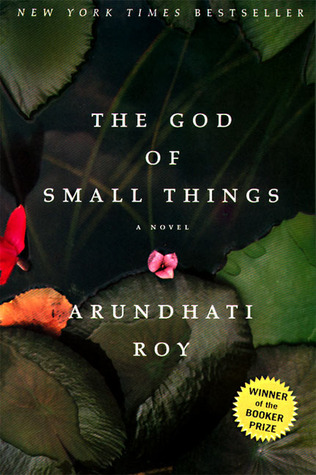 The story is about a broken family in Ayamenem, an exciting visit from Sophie Mol, the cousin from London, and Esthappen’s two thoughts: Anything can happen to Anyone and Its best to be prepared. It takes place in different moments of the twin’s lives and it goes through generations of the same family. Even though the decline of this Indian family is the underlying tone, it describes life in Kerala, the struggles of different social classes shown through Velutha, and the interactions with London as a culture embedded on the cousin, Sophie Mol. Most importantly, it transcends cultures and countries. I shared the twins’ excitement when they went to see the “The Sound of Music” for the third time, and sang-a-long when Estha could not hold back singing in the middle of the theater. I could imagine Rahel with her “love-in-Tokyos,” her feeling she was the ambassador of her reality and her angry colored glasses.
It’s a terrible story, told in the most beautiful way
About Arundhati Roy
Arundhati Roy was born on November 24, 1961, she grew up in Ayamenem, Kerala and studied Architecture in college.
She published “The God of Small Things” in 1997, for which she won the Man Booker Prize. For 20 years she only wrote nonfiction, until 2017 when she published “The Ministry of Utmost Happiness.”
She is a political activist, mostly in environmental and human rights causes. She published articles about the US war with Afghanistan, the Indian government’s nuclear policies, the genocide of Tamils in Sri Lanka, among others.
Other book written by Indian Women
We just recommend books we’ve read
- The Ministry of Utmost Happiness – Arundhati Roy (Read by Angelica)
- The Namesake – Jhumpa Lahiri (Read by Ceci)
- The Low Land – Jhumpa Lahiri (Read by Angelica and Ceci)
- The Inheritance of Loss – Kiran Desai (Read by Angelica and Ceci)
Which book do you recommend? Please let us know in the comment section!
Indian initiatives and projects that support and empower girls and women
 Girls Stars is an initiative that features short films about Indian girls shown in television and other media channels. The purpose of the initiative is to encourage girls to pursue more education by providing them with real-life examples of girls in similar situations.
Zubaan books started in 1984 as “Kali for women,” Indian’s first feminist publishing house. It focused on publishing academic books, fiction and small pamphlets about prominent authors. In 2004, the creators decided to make their own publishing house. Apart from publishing books for and about women, it has other projects about gender and the women’s movement is South Asia.
 The Map of Fiction by Women